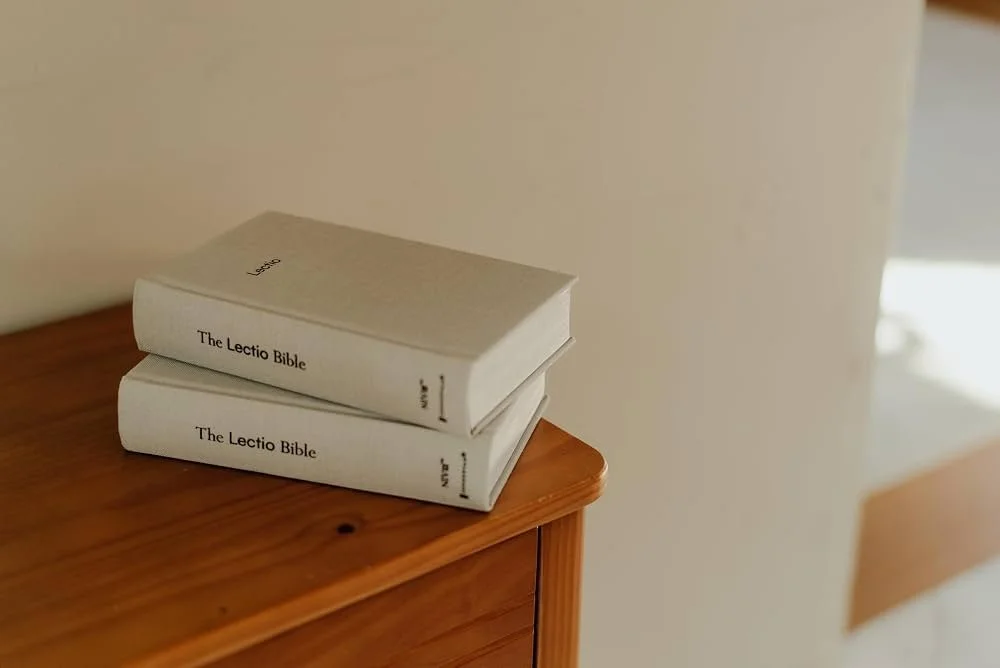
Most of us have a Bible on a shelf somewhere that we mean to read more. Maybe a few of them. I know I do: study Bibles, journaling Bibles, interlinear Bibles, and a couple I don't even remember buying. But the one I keep reaching for lately is the Lectio Bible, and I think it might be the most readable devotional Bible out there.
The Lectio Bible (the full name is the NIV Lectio Bible) is a reader's Bible from Zondervan, published in January 2025 with an introduction by John Mark Comer. It has no chapter numbers, no verse numbers, and no footnotes. It's just the text, laid out so you can sit down and read it. That's pretty much the whole idea, and honestly, it's refreshing.
What Is the Lectio Bible?

The Lectio Bible was made as a companion to Practicing the Way, the nonprofit John Mark Comer founded to help churches apprentice in the way of Jesus. If you know his name, it's probably from books like Practicing the Way and The Ruthless Elimination of Hurry. This Bible is built around what they call the Scripture practice, one of the nine practices they teach for living like Jesus in everyday life.
The name tells you what it's for. Lectio is Latin, and it means "a reading." It comes from the verb legere, to read. If the word sounds familiar, it might be because of lectio divina, a very old way of reading Scripture slowly and prayerfully. Benedict built it into the daily rhythm of his monks back in the 500s (it's in chapter 48 of his Rule), and in the 1100s a monk named Guigo II described it, in a letter now known as The Ladder of Monks, as a ladder with four rungs: reading (lectio), reflecting (meditatio), praying (oratio), and resting in God (contemplatio). The Lectio Bible's subtitle is "A simple, ancient way to read the library of Scripture," and that's the tradition it's pointing back to.
Side note: library is a good word for it. Our English word Bible comes from the Greek τὰ βιβλία (ta biblia), which just means "the books." Plural. The Bible was a collection of writings long before it was one book with a leather cover, so a Bible that lets each of those books read like a book is getting at something true about it.
Key Features of the Lectio Bible
The biggest one is that there are no chapters or verses. The writers never put them there, because Paul was writing letters and the Gospel writers were telling the story of Jesus. Chapter divisions didn't show up until the early 1200s, and New Testament verse numbers came in 1551. (I've written more about how chapter and verse numbers were added much laterand what that did to the way we read.)
Here is an example. Imagine your grandmother writes you a letter, and before it gets to you, somebody goes through and stamps a little number in front of every sentence. You could still read it. But you'd probably start reading it differently, pulling out sentence 14 and sentence 22 instead of hearing what she was actually trying to tell you. That's what a lot of us do with Philippians without even realizing it. Take the numbers away and the stop and go goes with them, so you engage with the Bible as literature and you get lost in the story.
The binding lays flat. If you've ever tried to read a Bible that won't stay open unless you hold it with both hands, you know why that matters. This one sits open on a table or in your lap, with no page flipping or fidgeting required.
The cover is cloth over board, a hardcover with a soft, natural texture that just feels good in your hands. It's simple and understated, and yes, it looks great on a nightstand or a bookshelf. That matters too.
The text is set in a single column, so it reads more like a book than a textbook, which helps a lot with focus and flow.
And it's the NIV. While I usually teach from the NET, the NIV is what I first read as a new Christian, and it still holds a special place in my heart. It's clear and readable, and Zondervan calls it the most widely read modern English translation, which makes it a good fit whether you've been reading for years or you're opening a Bible for the first time.
Why I Love the Lectio Bible
I've tried a lot of Bibles, but the Lectio Bible has become my favorite for one simple reason. It invites me to read. Not to analyze or decode or cross reference, but to simply read and receive.
When I do my own devotions, I'm not looking to parse Greek verbs or compare manuscripts. I just want to sit in the story of Scripture. I want to hear from God, and this Bible helps me do that. If you've ever found yourself distracted by footnotes, or trying to study your way into intimacy with God, the Lectio Bible is a welcome breath of fresh air.
It fits with the rest of what Comer teaches, too. You can't really read this way in a hurry, and I think that's part of the point, because God isn't in a hurry either.
What Makes It Better Than Other Reader's Bibles?
The Lectio Bible isn't the first of its kind. Crossway's ESV Reader's Bible came out in 2014, and the single volume edition drops verse numbers, footnotes, and section headings but keeps small chapter numbers (Crossway also makes a six volume set with no chapter numbers at all). Bibliotheca, a project by book designer Adam Lewis Greene that started as a massive Kickstarter campaign that same year, splits the Bible into several cloth volumes and uses the American Literary Version, an update of the 1901 American Standard Version, so the English has an older feel to it.
Here's where the Lectio Bible shines for me. It's one volume you can actually carry around, and it pairs no chapter or verse numbers at all with a modern translation that doesn't trip you up while you read. If the ESV is your translation, the ESV Reader's Bible is a great choice, and if you want something that feels like an art book, Bibliotheca is worth a look. For everyday devotional reading, though, the Lectio is the one I keep picking up.
Who Is This Bible For?
I think the Lectio Bible is a great fit if you're new to the Bible and a little intimidated by the way most Bibles look on the page. It's also great if you've been reading for years and want a fresh rhythm for your devotional time, if you just want a minimal, undistracted way to read, or if John Mark Comer's work has shaped you and you want a Bible that goes with it.
It may not be ideal if you're doing deep study (use a good study Bible for that), if you need footnotes or reference tools, or if you lean on chapter and verse to find your place. Following a reading plan, or keeping up with a group that says "turn to John 3," is harder without the numbers. And the print runs small, around 9.5 point, so if your eyes need large print, look at one in person first.
Is the Lectio Bible Worth It?
Yes. 100%.
If you want to really sit with the story of the Bible, without dissecting it or hunting for one liners, the Lectio Bible is a phenomenal resource. It strips away the noise and lets the text breathe, and in a world full of spiritual noise, that's exactly what a lot of us need. I wasn't paid to say any of that. It's just a resource I love and wanted to share.
And if Bible reading has started to feel like a checklist for you, this might be a good way to set the checklist down for a while. So, back to that Bible on your shelf. When was the last time you read one book of it the way it was written, start to finish, in one sitting? Philippians takes about 15 minutes. Maybe start there.
Where to Get the Lectio Bible
You can grab the Lectio Bible on Amazon, and honestly, it makes a great gift, for yourself or for someone stepping into Scripture for the first time.
Related resources from John Mark Comer:
Sources and Further Reading
Benedict. RB 1980: The Rule of St. Benedict in Latin and English with Notes. Edited by Timothy Fry. Collegeville, MN: Liturgical Press, 1981.
Guigo II. The Ladder of Monks and Twelve Meditations. Translated by Edmund Colledge and James Walsh. Kalamazoo, MI: Cistercian Publications, 1981.
NIV Lectio Bible: A Simple, Ancient Way to Read the Library of Scripture. Introduction by John Mark Comer. Grand Rapids: Zondervan, 2025.