The Garden of Eden Was Never About How the World Began
Ask most people what the Garden of Eden means and you'll get some version of the same answer. It's where it all started. The perfect place we lost. And for a lot of us who grew up in church, it was also a battleground: six literal days or not, evolution or creation, how old is the earth.
I understand why those questions hold such a deep place in people's hearts. That's how many of us were introduced to Genesis. But what if, that was never the question the writers were asking? I've written before about why Genesis 1 was never a science textbook. Here's where I land on the garden: Genesis 1 and 2 aren't telling you how the world got here. They're telling you who runs it. And once you see that, Eden stops being a place we lost and starts being a job we were given.
I'm not throwing out the Bible. I think this is a better way to read it, and a more honest one, because it's how the people who wrote it would have read it. So let's go back to their world.
The world that shaped Genesis
In 586 BC, Babylon conquered Judah and burned Jerusalem, temple and all. The priests, the scribes, and the people with authority were carried off to Babylon. A few decades later, in 539 BC, Persia took Babylon, and Cyrus the Great did something unusual: he let conquered peoples go home. It was strategy as much as kindness. Persia ruled by striking deals. Keep your city, keep your worship, just pledge loyalty and send soldiers when we go to war.
That homecoming matters, because most scholars believe the Torah, the first five books of your Bible, took its final shape in this Persian period. Not that someone wrote it all down for the first time. Older stories and writings were preserved, collected, edited, and arranged as the people came back to rebuild. And like the Gospels, the Torah was arranged on purpose, not to give us video camera footage, but to say something deeper than the events themselves. (It helps to remember that chapters and verses were added much later.)
Now put yourself in their shoes. You've spent seventy years in exile. You've married and raised kids under a foreign king. You've watched empire after empire decide your future. The question keeping you up at night isn't how the atoms formed. It's this: is our God still on the throne?
The Persian world gave them a powerful picture for answering that question. Persian kings built royal gardens they called pairidaēza, which literally means "a wall around." Ordered rows of trees, channels of running water, the whole thing a statement of the king's power to bring order and life. The Greek historian Xenophon tells a story about a Spartan general named Lysander visiting the Persian prince Cyrus (the grandson of Cyrus the Great) around 407 BC. Lysander was stunned by the garden's perfect rows and asked who had laid it out. Cyrus said he had, and that he planted some of the trees with his own hands. Lysander looked at the purple robes and gold jewelry and couldn't believe it. Cyrus swore he never ate dinner without first working up a sweat, either training for war or working the ground. A king with dirt under his fingernails.
The Greeks borrowed the Persian word as paradeisos, which is where we get "paradise." Hebrew borrowed it too, as pardes. In Nehemiah 2:8, Nehemiah asks the Persian king for a letter to Asaph, the keeper of the king's pardes, so he can get timber to rebuild Jerusalem, including the gates by the temple. They literally rebuilt around God's house with wood from the king's paradise. And when Jewish scholars translated the Hebrew Bible into Greek, they used paradeisos for the garden in Eden. Eden became paradise.
So when people living in that world told a story about God planting a garden, with a river flowing out to the four corners of the earth and his image placed inside to tend it, they knew exactly what they were saying. So did everyone listening.
That's also why the order of the chapters matters. Genesis 1 and Genesis 2 are two different creation stories, and most scholars agree the Genesis 2 story is the older one. So why put the newer one first? Read Genesis 1 and notice the rhythm. God speaks, and it happens. Over and over. No struggle, no battle, just a king whose word is enough. That's how a royal decree sounds. For a people coming out of exile, it was a declaration that their God wasn't one more local deity who lost a war. He was over every empire that had ever pushed them around. And seven times he looks at what he's made and calls it good, tov. Blessing comes before anyone does anything right or wrong, which means when things go sideways in Genesis 3, the brokenness is an intrusion into God's good world, not its foundation.
Then comes the twist:
"Then God said, 'Let us make human beings in our image, to be like us. They will reign over the fish in the sea, the birds in the sky, the livestock, all the wild animals on the earth, and the small animals that scurry along the ground.'" (Genesis 1:26, NLT)
Ancient kings set up images, statues, in the territories they ruled, so everyone passing by remembered who was in charge. The Hebrew word is tselem. Genesis puts God's image in the world too, but it isn't stone or wood. It's people. All of them, male and female. (More on what it means to be made in God's image.) Genesis 1 isn't "here's how God made the world." It's "here's who the world belongs to." For people who had just spent seventy years under somebody else's king, that's not a science lesson. That's defiance.
The Garden of Eden was a temple
But this King doesn't rule from far away. Like Cyrus in his garden, he gets his hands dirty.
"Then the LORD God formed the man from the dust of the ground. He breathed the breath of life into the man's nostrils, and the man became a living person. Then the LORD God planted a garden in Eden in the east, and there he placed the man he had made." (Genesis 2:7 to 8, NLT)
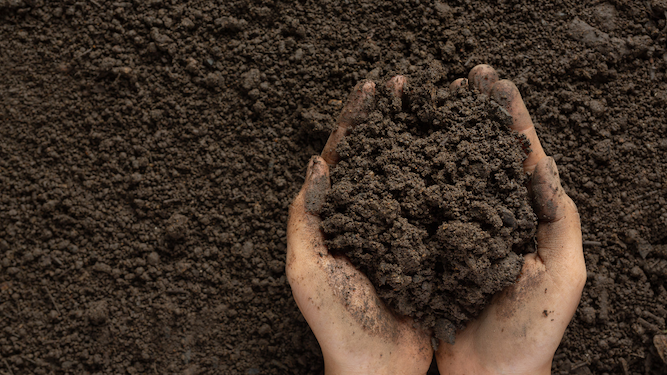
God forms. God plants. "Formed" is potter's language, hands soaked in clay. "Planted" is gardener's language. This isn't a king shouting orders from a balcony. This is a king on his knees in the soil.
And look at how Eden is described. Gold and onyx in the land (2:11 to 12), the same materials used for the tabernacle and the priest's garments. An entrance on the east, guarded by cherubim (3:24), just like the tabernacle with cherubim woven into its curtain. God walking in the garden (3:8), the same verb used for God walking among his people in Leviticus 26:12. A river flowing out from the center to water the world, just like the river flowing out of the temple in Ezekiel 47. For an ancient Israelite, a garden with God in the middle of it wasn't a park. It was a temple. Eden is the first holy of holies, and for a people trying to rebuild their temple, that story would have landed as encouragement.
Then comes the job description:
"The LORD God placed the man in the Garden of Eden to tend and watch over it." (Genesis 2:15, NLT)
Those two verbs are avad and shamar. Avad means to work or serve. Shamar means to guard or keep safe. Later, in Numbers 3:7 to 8, the same pair describes the work of the priests in the tabernacle. So the first job description in the Bible is written in priest language. The first temple was a garden, and the first priest was a gardener.
John Walton, in The Lost World of Genesis One and The Lost World of Adam and Eve, puts it this way: a house isn't a home until people move in and care for it. God built the house. Our job is to fill it with life and make it good. And notice that the river flows out. The garden was never meant to stay walled in. Humans were placed in it to extend it, to make more of the world look like Eden. That's what it means to cultivate and care: we bring TOV to the world around us, the same good God built into creation.
It's a partnership. In the ancient world, people existed to feed the gods. This God says something completely different: I made you priestly. Peter picks up that language too, calling God's people a royal priesthood and a holy nation (1 Peter 2:9). (If you want to go further, here's more on humanity's role in Genesis 2.)
So here's the plane landing. Genesis isn't an answer to how things got here. It's an answer to who's still on the throne when everything has gone sideways, and what he made you to do about it. That's a word for right now. Whether you lean left or right, you've probably looked at the other side and thought everything is going to hell. Genesis 1 and 2 invite you into a realignment. The writers weren't fighting science; they were living under empire and declaring that the real King hasn't left the throne. You are his image, not a spectator and not a statue, but a living sign of his rule wherever you stand. And your work is priestly work. The teacher, the barista, whatever your vocation, you're a priest in that place, bringing a little paradise to the people around you. (I've written more on what God meant by work.)
Cyrus planted his garden to show the world what kind of king he was. God did too. He knelt in the soil, formed you from the dirt with his own hands, planted a garden, and then handed you the tools: now you. Work it. Keep it. Take it everywhere.
So here's the question I want you to sit with: what would it look like to plant a garden right where you are?