Some inventions change everything. If you made a list of the top 10 inventions in human history, I'd argue the printing press belongs on it, and some people would put it in the top five. The best comparison I can come up with is the internet. Before the press, everything had to be copied by hand and passed around slowly, and after it, words could move faster than anyone had ever seen. It created something like the first feed in human history, and the first big book it fed out to the world was the Gutenberg Bible.
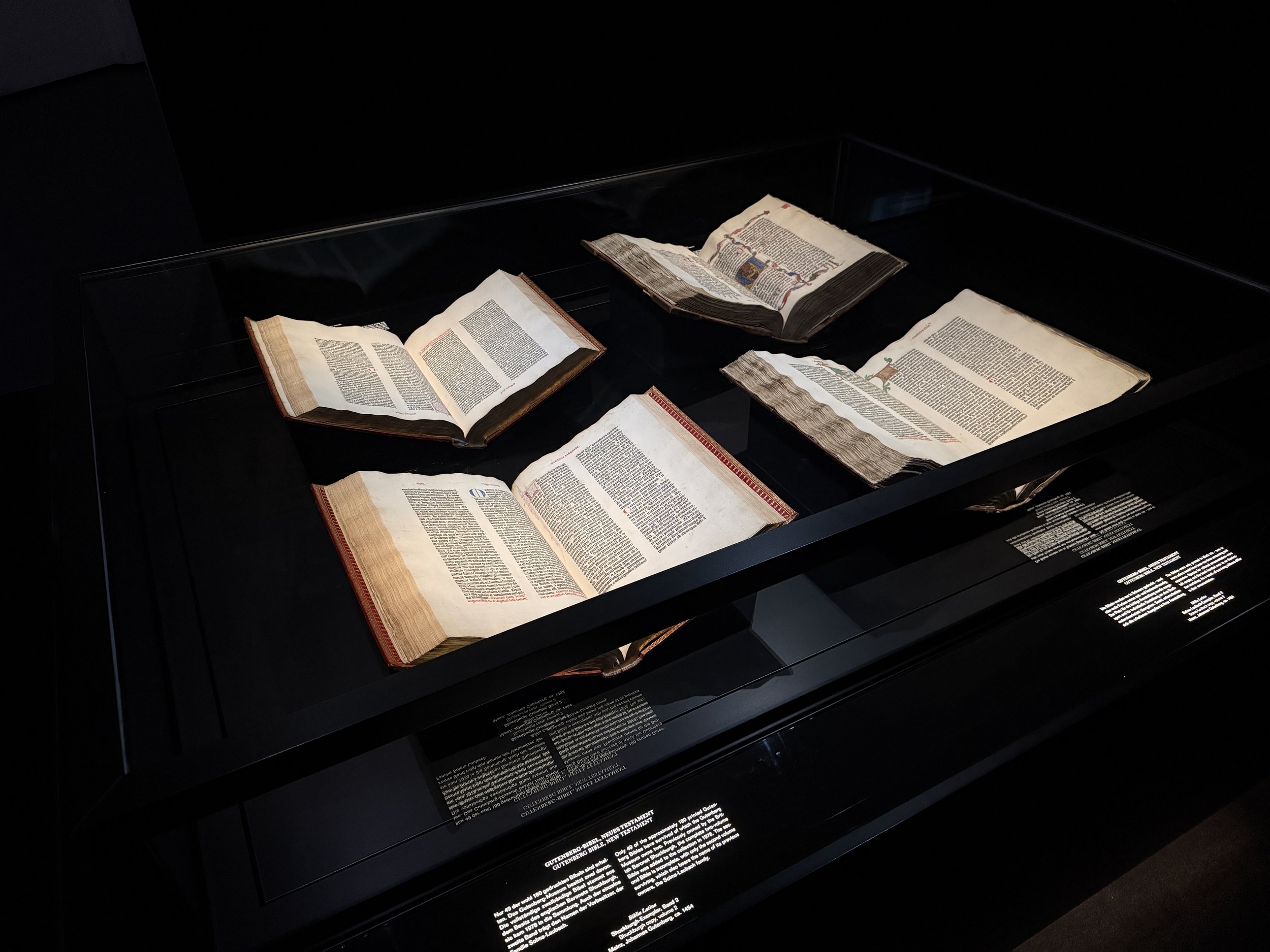
A few weeks ago I got to stand next to one. The Gutenberg Museum in Mainz, Germany, has two Gutenberg Bibles behind glass, printed around 1455, the first major book in Europe printed with movable type. It's not often in life you get to stand next to something that changed the course of human history. And I'll be honest, I walked in with a story already in my head. You probably have it too. Gutenberg invents the printing press, Luther grabs it, and boom, everybody gets a Bible in their own language. The little guy finally gets to read God's word for himself.
That story is mostly true. But the way we usually tell it gets a few things wrong, and honestly, the real story is better. What if the idea that anybody, anywhere, could hear God in their own language didn't start in a print shop in Germany at all?
Here is what I believe. God was already doing that long before Gutenberg ever showed up. To see it, we have to go back to a festival in Jerusalem, about 1,400 years earlier.
Babel in Reverse
I grew up in a Pentecostal tradition, so Acts 2 is very familiar to me. It's something of a highlight reel in Pentecostal theology for how the Spirit moves. In my opinion, though, the more important part of the story is what comes after the Spirit shows up.
Luke wrote two volumes, Luke and Acts, and they're meant to be read together. At the end of Luke, Jesus tells his followers to wait in Jerusalem for the promised Holy Spirit. In Acts 2, about 120 of them are together in one room on the day of Pentecost. Side note: Pentecost was a Jewish festival long before it was on any church calendar, and Jews from all over the world traveled to Jerusalem for it. That detail matters, because the city was full of people who didn't grow up speaking the local language.
The Jewish people had been spread out for centuries, ever since Babylon conquered Jerusalem, and on through the Persians and the Greeks. They set up shop in other countries and stayed, and their kids grew up speaking those languages. Alexandria in Egypt had one of the largest Jewish communities in the world. So when a sound like a violent wind fills the house and the believers start speaking in other languages, the crowd that gathers outside is a crowd from everywhere.
"At that time there were devout Jews from every nation living in Jerusalem. When they heard the loud noise, everyone came running, and they were bewildered to hear their own languages being spoken by the believers. They were completely amazed. 'How can this be?' they exclaimed. 'These people are all from Galilee, and yet we hear them speaking in our own native languages!'" (Acts 2:5 to 8, NLT)
Put yourself in their shoes. It would be like me, an American who doesn't speak a lick of German, showing up in Mainz and speaking fluent German. People would stop and stare. These were locals, Galileans, and somehow each visitor heard them in the language from back home. Luke even lists where they came from: Parthians, Medes, Elamites, people from Mesopotamia, Judea, Cappadocia, Egypt, Libya, Rome, Crete, and Arabia. And he tells us what they were hearing: "we all hear these people speaking in our own languages about the wonderful things God has done!" (Acts 2:11, NLT). Some in the crowd just laughed it off and said the believers were drunk on new wine.
Scholars often call this Babel in reverse. In Genesis 11, the whole world speaks one language, and the people try to build a tower up to the heavens to make a name for themselves. God comes down and confuses their language.
"That is why the city was called Babel, because that is where the LORD confused the people with different languages. In this way he scattered them all over the world." (Genesis 11:9, NLT)
Right before that story, Genesis 10 gives us what most Bibles title the table of nations, a list of the peoples that came from Noah's sons and spread out over the earth. Luke's list in Acts 2 uses different, first century names, and it does the same job, because the whole known world is in the room. There's a word link too. In the Septuagint, the Greek translation of the Old Testament, the word for confused in Genesis 11 is συγχέω (syncheō), and Luke uses the same root in Acts 2:6 for the bewildered crowd. It's like Luke is hyperlinking back to Babel.
And notice that God doesn't make everyone speak one language again. At Babel, people used language to build up their own name, and they got scattered. At Pentecost, God comes down again, the scattered nations get gathered, and each one hears the good deeds of God in their own language, gathered around his name. The point of Pentecost isn't a supernatural gift you use to find your own connection to God. It's the healing of the things that divide us as people, with every language still in the room.
God's good deeds weren't reserved for the elite, or for people who happened to speak the right language. And the New Testament writers were already living this out. They mostly quoted the Septuagint, a translation made in Alexandria for Greek speaking Jewish communities, so their Bible was a translation. They wrote in Koine too, the common marketplace Greek people spoke on the street and around the dinner table.
Why Was the Bible in Latin?
Over time, Latin took over from Greek as the language of the Roman world. Around 400 AD, Jerome translated the Scriptures from Hebrew and Greek into Latin, and it was a Bible people could actually read. But languages change. Over the next thousand years Latin stopped being anything people spoke at home, and the Bible stayed in Latin. Only priests and scholars could read it.
Imagine that for a second. We all have Bibles in our hands and we can read them in our own languages. But for centuries, the only way most people heard the Bible was at mass, in a language they didn't speak, and they hoped the priest was telling them what it actually said.
That's the world Gutenberg printed into. Around 1455 he printed about 180 Bibles, and roughly 49 survive today, and they were in Latin. They were sold mostly to churches and the wealthy, and buyers would hand the printed pages to an artisan who painted in the colors and decorations by hand, so every copy was unique. My grandmother had a big family Bible on her coffee table when I became a Christian, the kind with the family tree written in the front. Think of it like that. Gutenberg went broke on the whole thing and died in 1468. Luther wasn't born until 1483, so the two of them never met.
What Luther had was the wisdom to see what Gutenberg's invention could do. Gutenberg's shop in Mainz had printed some of the first indulgence certificates back in the 1450s. By Luther's day, the Archbishop of Mainz was running an indulgence campaign tied to raising money for St. Peter's Basilica. Officially, you paid to reduce time in purgatory for yourself or a loved one, but on the popular level it got heard as paying for the forgiveness of your sins. Luther thought that was a problem, and in 1517 he mailed his 95 Theses to the Archbishop of Mainz. Printers in other cities picked them up, and within weeks they were all over Germany. The invention that printed indulgences ended up printing the protest against them.
Then came the pamphlets. Think of a pamphlet like someone's personal newsfeed, the person on Facebook or Instagram posting their take on theology all day long. And in 1522, Luther translated the New Testament into German in about 11 weeks. There were already German Bibles before his, but they were stiff, word for word translations that were hard to read. Luther wanted the mother in the home and the children in the street to be able to read it. He did for German what the New Testament writers had done with Koine. In England, William Tyndale did the same for English and was killed for it in 1536, and he wasn't the only one who paid for it with his life.
Who's at the Table?
So, back to Mainz. Standing in front of that press, I realized it was responsible for something else. Every Bible came with somebody's hot take on it. Luther did it, the Archbishop of Mainz did it, and we still do it today. For a lot of us it was rapture charts and camp talks. The text and someone's opinion about the text have gone hand in hand since the very beginning.
Sometimes we react to that by saying, "I just need me and my Bible." I think that's a fallacy, because even if it's just you and your Bible, you still have your own hot take about what it means. You can't have one person deciding what it all means. The Bible was meant to be read in community, wrestled with alongside the people around you. Remember how Acts 2 ends.
"All the believers devoted themselves to the apostles' teaching, and to fellowship, and to sharing in meals (including the Lord's Supper), and to prayer." (Acts 2:42, NLT)
Reading with other people is how you test your hot take. It's how you wrestle with the opinions you hold dear. That's why we meet for Barstool Theology here in the Treasure Valley, so people can sit across from someone who sees it differently and ask the questions they were afraid to ask, in a place where it's safe to ask them. If you want somewhere to start on your own reading, I've written about a better way to read the Bible, and about what unity might actually look like when we don't all agree. And if church has been the place where questions got you in trouble, I get it. I've also written about why church can feel so unsafe.
When I looked at those Bibles behind glass in Mainz, preserved and ornate and in a language only a few could read, it kind of broke my heart. I wondered how many centuries went by where all people knew about the Bible was what someone else told them. We get to live in a moment where we can sit down and argue about what a passage means, in our own language, over a drink. That's a privilege that is new to human history, and we shouldn't treat it as elitism. God has always spoken in your language, and he always meant for you to hear it with other people. That's what the goodness of God looks like around a table.
So, who's at the table when you read?
If this was helpful, feel free to pass it along to someone else you think would benefit from it. And if you'd like new posts like this one in your inbox, subscribe to Stories of TOV.