Reading Revelation as a Chiasm: Part 2
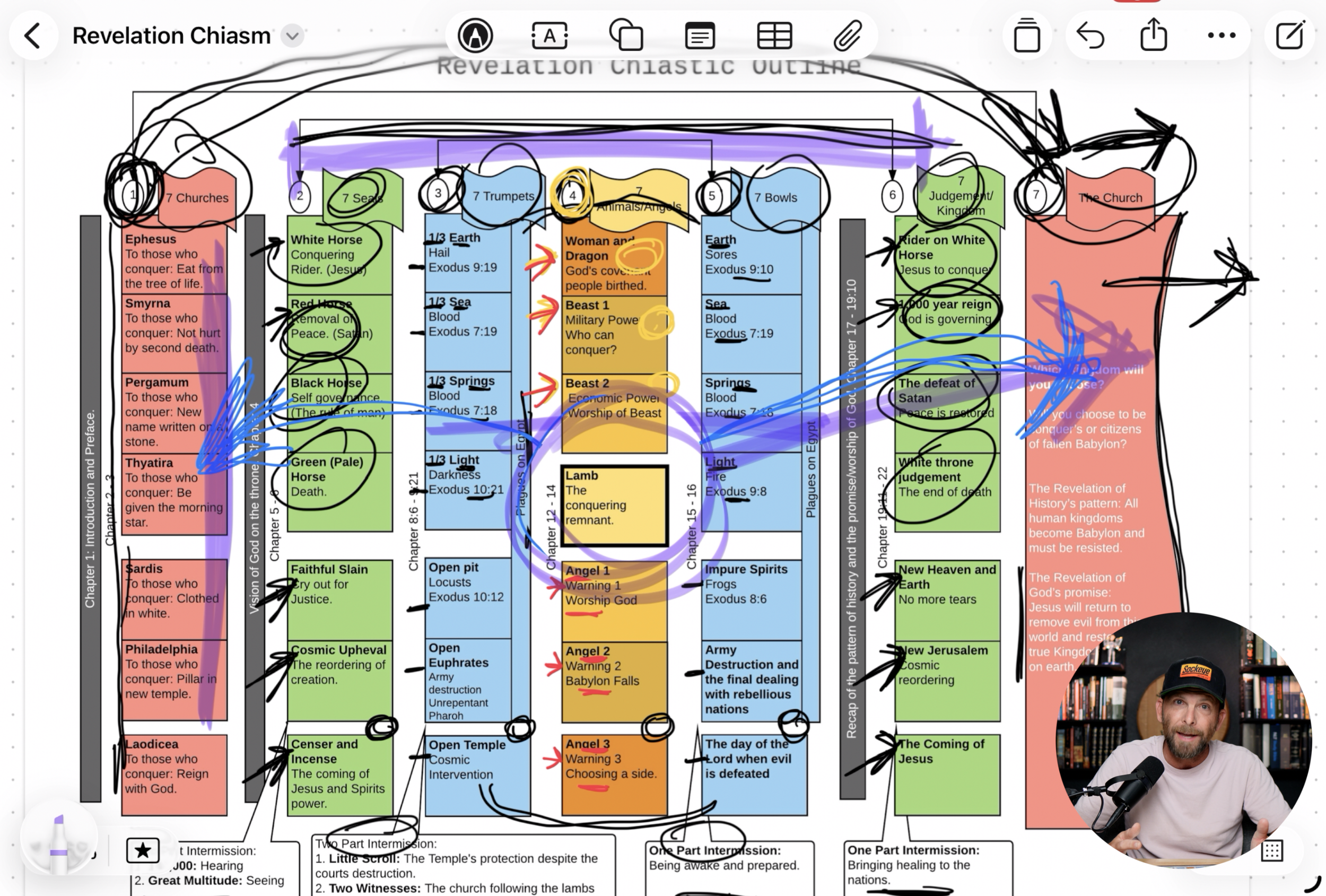
Let's talk about structure.
Most of us have been trained to read Revelation wrong. We open it looking for hints about the future, scanning for clues about current politics, trying to decode who the Antichrist might be. We treat apocalyptic literature like a coded message about tomorrow instead of what it actually is: metaphors, typology, and symbolism about power, kingdom, and who's really on the throne right now.
Here's the thing. If you've been reading Revelation to foretell events coming up in our world, you're probably reading it incorrectly. This isn't about the future. It's about who's on the throne.
And there's a way of reading this text that maybe you've never considered before. A way that changed everything for me about how I understand this entire book.
The Apocalypse of John is structured as a chiasm. Not just sections of it. The whole thing.
What Is a Chiasm?
Let's start with the basics. A chiasm is a literary device used in both Greek and Hebrew literature. It's a way of organizing ideas so they're memorable and carry a specific point.
Think of it as a mirror structure. You write something like A-B-B-A. The outer sections echo each other. The inner sections echo each other. And the center point, that fulcrum in the middle, that's the main thing you're trying to communicate.
The Greek word comes from the letter chi, which looks like an X. The structure mirrors that shape: symmetrical, balanced, pointing to a center.
Chiasms show up everywhere in the Hebrew Bible and the New Testament. The Jewish people used them constantly when they wrote. But here's what's interesting: scholarship on chiasms in Scripture is actually quite recent. The church fathers didn't talk about them much. It's modern biblical scholarship that's uncovered these patterns were intentional all along.
If you have eyes to see, chiasms are there. And I believe John used this structure throughout the entire Apocalypse.
Key Takeaways
A chiasm is a mirror-structure literary device with the pattern A-B-B-A.
Chiasms were used in both Greek and Hebrew literature for emphasis and memorability.
This is an ancient literary technique, not something new we're imposing on the text.
Why John Would Have Used This Structure
Here's the thing about John. Whether he was the Apostle or the Elder (and yes, there are theories about which), he was Jewish. He would have been thoroughly familiar with chiastic structures. This literary device wasn't exotic to him. It was native to how his people wrote.
Now think about his situation. John was writing to multiple churches across different cities. He was trying to send a message that would stick. That would be remembered. That would be retold and carried forward.
Chiasms are designed to be memorable. They're built for oral tradition and retelling. John's apocalypse is vivid and memorable. He's writing to a persecuted people who need this message to sink in. Using a chiastic structure would help these churches remember and carry this message forward for generations.
The Structure: Seven Sevens
When you map out Revelation's chiastic structure, something jumps out immediately. There are seven major sections. And within each of those seven sections, there are seven sub-sections.
Seven sevens.
Now, if you know anything about biblical numerology, you know that seven means completeness and wholeness. It was crucial to the Jewish imagination. So is it coincidence that John organized this thing into seven sevens? I don't think so.
I think it's intentional. I think he's signaling something to his readers: "Here's the complete, whole picture of what I'm communicating."
Each section maps onto another section in reverse order. The first maps to the last. The second maps to the second-to-last. And they keep echoing each other until you reach the center. That center point, the fulcrum, is the point of the whole thing.
Key Takeaways
Revelation contains seven major sections, each subdivided into seven parts.
This structure is intentional, not accidental.
The repetition of the number seven (completeness) signals the wholeness of John's message.
In chiastic structure, the center point is the focal point of the entire composition.
The Frame: Churches and the Church
The opening section addresses seven specific churches. Each one gets a direct message. But here's what's interesting about how those messages are framed.
Every single one ends with some version of the same idea: "To those who conquer."
To those who conquer, they eat from the tree of life. (Ephesus)
To those who conquer, they're not hurt by the second death. (Smyrna)
To those who conquer, a new name is written on a stone. (Pergamum)
To those who conquer, they're given the morning star. (Thyatira)
To those who conquer, they're clothed in white. (Sardis)
To those who conquer, they become a pillar in the new temple. (Philadelphia)
To those who conquer, they'll reign with God. (Laodicea)
(Revelation 1:4-3:22)
The encouragement is clear. These churches are called to be conquerors. But not conquerors in the worldly sense. This isn't about military might or political power. This is about conquering in the way of God's kingdom.
Now, here's the crucial part. This opening section maps to the closing section about the church itself. Not these seven churches in their particular cities, but the church as an ongoing reality moving forward.
John's trying to communicate something that will remain true for every generation of believers who come after.
The setup is this: Will you choose to be conquerors who receive the rewards of God's kingdom? Or will you be participants in fallen Babylon?
That's the frame. That's what holds the whole thing together.
Key Takeaways
The seven churches (Revelation 1-3) and the church as a whole (Revelation 19-22) form the outer frame of the chiasm.
Every church message emphasizes "conquering" in the kingdom of God, not worldly conquest.
This opening question applies to every generation: Which kingdom do you belong to?
The Central Question: Babylon or New Jerusalem
All of this middle stuff in Revelation is really about one question. Babylon or New Jerusalem. The kingdom of this world or the kingdom of God.
This is crucial. Let me unpack it.
Jesus came to establish a kingdom. Not a spiritual afterlife destination. Not a disembodied heaven somewhere up there. But an actual kingdom here on earth, now, through his people.
This is what the gospels are all about. If you want to understand what kingdom means in Jesus's teaching, go read those accounts of his life.
Jesus established a kingdom through his people and expected it to continue. The way of Jesus was supposed to move into the hearts and minds of all people everywhere.
Go and make disciples of all nations, baptizing them in the name of the Father and of the Son and of the Holy Spirit. (Matthew 28:19-20)
That's the calling. That's the mission.
But here's the problem. If God's kingdom is the real kingdom, then the kingdoms of this world are at risk of being exposed as false. They're at risk of being defeated. And they don't like that.
So they resist.
And that resistance is what John calls Babylon.
The early people who followed Jesus understood this. Maybe they didn't even call it Christianity yet. They called it "the way" (see Acts 9:2, 19:9). They understood that following Jesus meant living differently. And that difference brought challenges. Real challenges. It brought tension with the power structures around them. It brought real cost.
The Apocalypse as a Document of Hope
Here's what I need you to understand. The apocalypse is not trying to terrify you.
If Revelation scares you or gives you anxiety, you're reading it wrong.
This text was written to give hope to people in crisis, not to cause fear. This is crucial for how we approach the whole thing.
The early Christians were living under empires that didn't want them to exist. They were facing real pressure to compromise, to bow to the deities of empire, to participate in systems that contradicted the kingdom of God.
And they could look around and think: "Where is God? How is this kingdom real when everything around me says otherwise?"
That's who this letter was for. That's why John wrote it.
The apocalypse is a revelation of the truth that Jesus is still on the throne. That throne and that kingdom will endure. It will come. It's for people who need to know that God is still in control, even when the world looks completely broken.
This is not a document of fear. It's a document of hope.
Key Takeaways
Revelation was written to encourage persecuted Christians, not to frighten them.
John's purpose is to affirm that Jesus remains on the throne despite the appearance of chaos.
The letter speaks directly to people living under oppressive empires.
The Heart: The Remnant Who Remains
The center of Revelation is somewhere around chapters 12 to 14. And this is the point where John reveals what he's really been talking about all along.
You have a woman and a dragon. You have the beast with military power. You have a second beast with economic power. You have the forces of empire and resistance clashing.
And then, at the turning point, you have the Lamb standing on Mount Zion with 144,000 who have not defiled themselves.
Then I looked, and here was the Lamb standing on Mount Zion, and with him were a hundred and forty-four thousand who had his name and his father's name written on their foreheads. (Revelation 14:1)
These are the ones who follow the Lamb wherever he goes. These are the ones who have refused to compromise.
This is the heart of it.
The question for every reader is this: Will you be that remnant? In the midst of all the chaos and conflict, will you be the people who choose God's way?
Because here's the reality that history keeps proving. Empires rise and empires fall. Every generation has its Babylon. Every generation has its beasts.
The question for you is not, "Is the Antichrist here? Can I decode who the beast is?"
The question is: "Will I resist the empire that's pressing on me right now?"
Tracing the Exodus Through the Structure
One thing that's fascinating to trace through the chiasm is how much Exodus language shows up. When John talks about the judgments that come, the plagues and bowls and trumpets, he's drawing language from the Exodus story.
Think about it. In Exodus, you have an oppressed people under a pharaoh who refuses to let them go. And God responds with judgment on that empire. God intervenes. He steps in and makes it right.
If you're a people group living under the thumb of empire, feeling like God is nowhere to be found, it makes perfect sense that John would reach back to that story.
You're like the Israelites calling out for help.
And the reminder is that God responds to oppression. God judges empires that rule in ways that contradict his kingdom.
Babylon and Egypt become synonymous in how the Bible talks about evil. They're both pictures of what happens when human power, unchecked, becomes destructive. And the promise is always the same.
God will make it right.
Key Takeaways
The plagues and judgments in Revelation echo the Exodus plagues.
This connection would have been immediately recognizable to John's Jewish readers.
The message: Just as God delivered the Israelites from oppression, God will deliver the faithful from Babylon.
So What? Reading This Now
Maybe you're wondering how this helps you read Revelation better. Maybe you're still asking how this all connects. So let me bring it home.
There are so many people who want to find all the clues in Revelation. They want to know who the Antichrist is. Is it this person? That nation? That political movement? Is the end happening now?
And here's what I want to tell you.
Every generation has an Antichrist. Every generation has a beast. You don't have to look to the future to find them. Empires and power structures that oppose God's way are around you all the time. Right now. In your world.
The challenge for you isn't to identify them from some future timeline.
The challenge is to see them in your present reality and choose to live differently anyway.
Empires will rise and fall. History shows us this over and over. Babylon always seems powerful until suddenly it's not.
And the question for you, looking at the world you're living in and the current empires that want to oppress you and take from you, is this:
Will you be a remnant that remains faithful?
Will you be the one who resists, even when that resistance costs something?
Will you follow the way of Jesus, which is to see the human in people and love them accordingly? Will you resist the temptation to grab and take for yourself, instead choosing to lower yourself so others can rise? That's the way of the kingdom. And it's a complete reversal of how empires operate.
The Hope That Sustains
Why has the church kept Revelation as part of its Scripture for so long? Because it's been something that encourages people, not discourages them.
It's been a piece of literature that says: "Yes, I see how the power structures of our day are just like Egypt wanting to take. But God will make right what has gone wrong."
That's the hope for all of us and for every generation.
As I live today, choosing to live in the way God is inviting me into his kingdom, the way that Jesus modeled for us, I can continue to live that way even in the midst of chaos. I can trust that one day God will make it all right in the end.
Revelation, the Apocalypse of John, is not about the future. It's about who's on the throne.
Jesus remains on the throne.
Your allegiance to him is what enables you to live faithfully through whatever world is in front of you.
That's the revelation. That's the good news. That's why this text has endured for almost two thousand years.
Closing: Part 2
This is how John structured his vision. This is how he organized the revelation.
The chiastic framework is essential. It changes everything about how you approach this book.
The structure itself is the message. The mirror, the repetition, the center point. John wasn't being mysterious. He was being clear.
Here's what I want to leave you with.
You live in a time when empires are still rising and falling. When power structures still resist the kingdom of God. When it still feels, sometimes, like Babylon has the upper hand.
But Revelation says this: Babylon isn't going to win. It's not going to win the day. What'll happen is that God's way, His kingdom, actually wins. It's a reversal of all of the things that we see in the world today.
That's the hope. That's the revelation.
And most importantly, you should be asking yourself the central question: Which kingdom will you choose?
On Chiastic Literature: Chiasms appear throughout the Hebrew Bible (Psalm 23, Isaiah 40, etc.) and New Testament. Modern biblical scholarship has increasingly recognized chiastic structures as intentional literary devices used for emphasis and memorability.
On Revelation's Purpose: Contemporary biblical scholarship broadly agrees that Revelation was written as an encouragement to persecuted early Christians, not as a predictive roadmap of future events. For further study on apocalyptic literature in its historical context, see works by scholars like G.K. Beale and Craig Koester, who emphasize the letter's function as resistance literature addressing first-century audiences facing Roman imperial pressure.