Understanding the Apocalypse of John and Its Message.
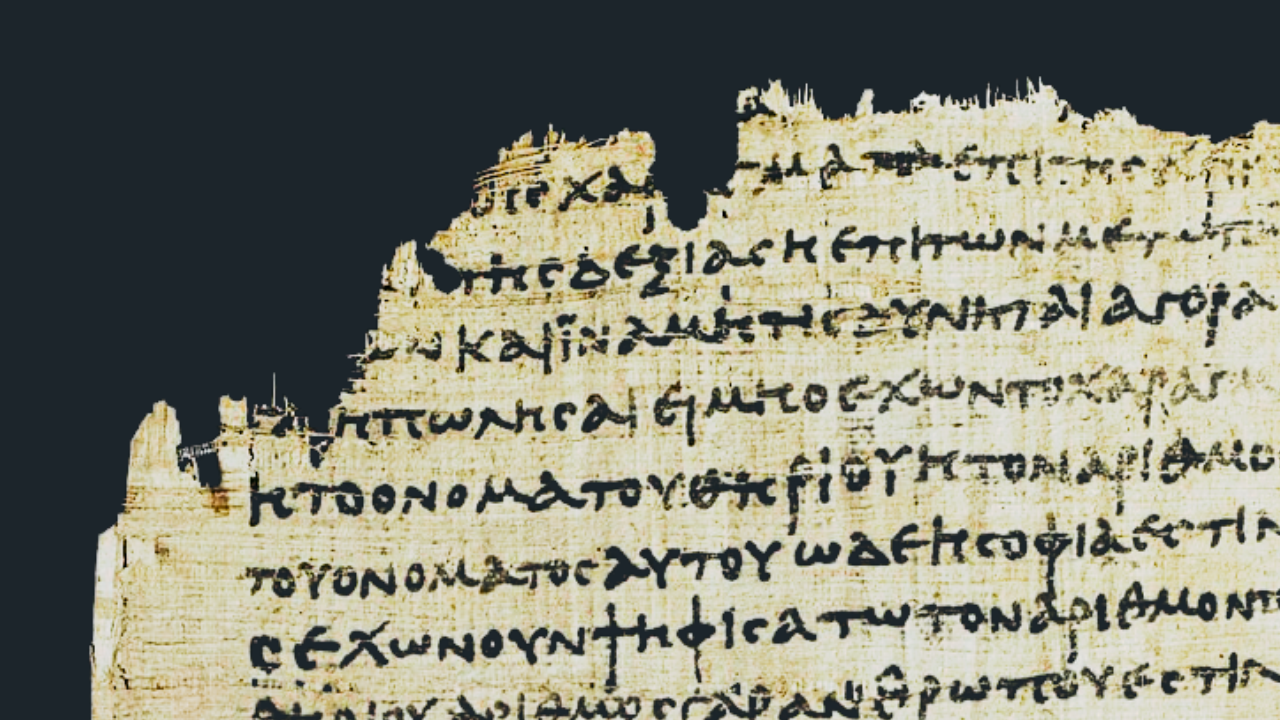
Let’s talk about Revelation.
This letter was not originally called "Revelation." A more accurate title would be "The Apocalypse of John."
What does "Apocalypse" mean? Well, we often associate the word with catastrophic end-times events, but the Greek word ἀποκάλυψις (apokalypsis) actually means "to uncover" or "to reveal."
So this letter is about uncovering, or revealing, something significant. John tells us as much from the outset: it is the revelation of Jesus Christ (Rev 1:1).
This framing helps us as we begin to explore John's purpose. He aims to reveal something essential about the nature and position of Christ, something his audience may have overlooked or forgotten.
This letter was written to particular churches in real cities, communities that are still known to us today.
Notice the geographical pattern in the map below. The churches follow a travel route, and that route matches the exact order John lists them in his letter.
What this shows is an intentional effort on John's part. He sent this letter in a way that fit both his readers and the road his messenger would travel. John didn't just have his audience in mind when he wrote; he intended for them to understand exactly what he was writing about.
God blesses the one who reads the words of this prophecy to the church, and he blesses all who listen to its message and obey what it says, for the time is near. (Rev 1:3, NLT)
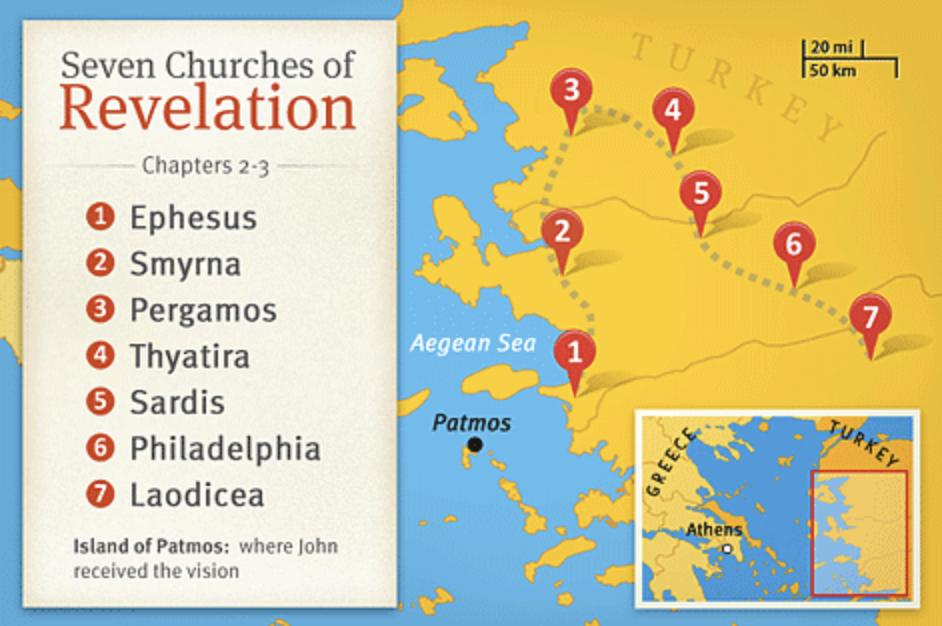
Notice the geographical pattern in the map.
The churches follow a travel route, and that route matches the exact order John lists them in his letter.
This marks a significant distinction between what most people think Revelation is about and what nearly all scholars agree it's actually about.
Ask almost anyone what Revelation teaches, and you'll likely hear something about the end of the world: the tribulation, the end of days, the final judgment of God. This view usually comes wrapped in the assumption of a not-so-distant future. But what we find in John's actual letter is something far less futurist, and far more meaningful for our present reality.
When Was the Apocalypse Written?
There are two candidate dates for the writing of this Apocalypse. Its consistent themes of persecution and conquering lead scholars to one of two possible conclusions: it was written either under Nero's persecution of Christians or under Domitian's.
Late 60s AD, under the persecution of Emperor Nero. Nero posed a clear threat to early Christians. Historians like Tacitus documented his cruelty toward the early Christian movement, including his decision to blame Christians for the Great Fire of Rome in 64 AD and the brutal executions that followed (Tacitus, Annals 15.44). Pliny the Younger's later correspondence with Emperor Trajan shows that within a few decades, Roman authorities still treated the Christian name itself as a punishable offense (Pliny, Letters 10.96), evidence of just how dangerous this allegiance remained. More modern scholarship has leaned toward an earlier writing date than the traditional view that John wrote in the late 90s.
Late 90s AD, under the persecution of Emperor Domitian. The more traditional view dates the Apocalypse to 95-98 AD, near the end of John's life. The case for severe persecution under Domitian has been harder to substantiate; little contemporary evidence survives. But the silence of history doesn't always mean the thing didn't happen. Several later writers describe Domitian's persecution of Christians: Melito, bishop of the church in Sardis, around 175 AD (preserved in Eusebius, Ecclesiastical History 4.26); Tertullian, around 197 AD (Apology 5); Eusebius himself, writing around 325 AD; and Hegesippus, writing sometime between 117 and 189 AD (also preserved in Eusebius, Ecclesiastical History 3.20).
Whenever this Apocalypse was written, we know it came during a time when professing allegiance to Christ brought severe trial and suffering.
What did people think of this letter in the early years of Christianity?
The reception was a mixed bag. Some liked it. Some didn't. Here's how Eusebius, the early Christian historian (263-339 AD), listed it among other known Christian writings:
At this point it seems appropriate to summarize the writings of the New Testament which have already been mentioned. In the first place must be put the holy quaternion of the Gospels, which are followed by the book of the Acts of the Apostles. After this must be reckoned the Epistles of Paul; next in order the extant former Epistle of John, and likewise the Epistle of Peter must be recognized. After these must be put, if it really seems right, the Apocalypse of John, concerning which we shall give the different opinions at the proper time. These, then, are to be placed among the recognized books.
Of the disputed books, which are nevertheless familiar to the majority, there are extant the Epistle of James, as it is called; and that of Jude; and the second Epistle of Peter; and those that are called the Second and Third of John, whether they belong to the evangelist or to another of the same name.
Among the spurious books must be reckoned also the Acts of Paul, and the Shepherd, as it is called, and the Apocalypse of Peter; and, in addition to these, the extant Epistle of Barnabas, and the Teaching of the Apostles, as it is called. And, in addition, as I said, the Apocalypse of John, if it seems right. (This last, as I said, is rejected by some, but others count it among the recognized books.) And among these, some have counted also the Gospel of the Hebrews, with which those of the Hebrews who have accepted Christ take a special pleasure.
— Eusebius, Ecclesiastical History 3.25.1-7
Notice how Eusebius lists the Apocalypse of John in both the recognized category and the spurious, or rejected, category. That tells us that by the fourth century, there was still real debate about this letter. (See also Ecclesiastical History 7.25 for more on how early Christians viewed it.)
By the early fourth century, at the Council of Carthage, the dispute was settled: the Apocalypse of John was ratified as part of our current canon (Canon 24, Greek numbering xxvii).
Who wrote the letter?
It may seem obvious at first glance, but the letter only identifies its author as "John." We might reasonably assume this is the same John who wrote the Gospel. Early sources like Clement, Justin Martyr, and Irenaeus attribute it to the disciple of Jesus. Modern scholars are more divided. Some propose John the Elder (Presbyter) as the author, a figure frequently floated as an alternative author for several of the Johannine writings in the New Testament.
Other Key Takeaways
This letter blends two main writing styles: epistle and apocalyptic (and possibly a third, prophecy).
It was meant to be read aloud, understood, and obeyed by its hearers (Rev 1:3).
John wants to encourage his listeners, the seven churches and the church as a whole, to endure their suffering, knowing that Jesus is king over the powers of evil now and forever.
Themes and Reading
Reading this Apocalypse, we're flooded with imagery, apocalyptic imagery, to be exact. These images would have carried meaning for the original readers, in their own moment. There is no secret code waiting to be cracked.
This Apocalypse reveals Jesus Christ and his work to establish the kingdom of God by overthrowing the kingdom of Babylon. What's true for the seven churches in this vision is true for us today.
But the images have to be rooted in what the seven churches could actually know and understand (Rev 1:3; 13:18). What John does with these images isn't so different from what marketing companies do today. We use donkeys and elephants as shorthand to signal political affiliation, social commentary on issues that divide people.
John does the same thing. The images and their meanings may feel foreign to us, but they would have been instantly recognizable to his original readers.
If we don't try to see these images the way John and his readers would have seen them, we run the risk of misreading the entire letter. Imagine handing the cover of Time magazine's November 24, 1994 issue to someone in a remote part of Africa, two thousand years from now, with no context. They might reasonably conclude that Americans had a serious elephant and donkey problem.

Time Magazine’s November 24th, 1994 cover issue.
That's exactly the point. To understand what the elephant and donkey actually meant, you'd need to do the work of learning the American political climate of the 1990s and the imagery that went with it. It's easy to forget that Revelation was written for an ancient (to us) audience, and that its pictures would have been immediate and real to the people living through that moment in history.
It's also worth understanding how John experienced this vision. There are clues within the text itself, and in comparable ancient literature.
One clue comes early, when John describes his encounter with the Lord Jesus:
It was the Lord's Day, and I was worshiping in the Spirit. Suddenly, I heard behind me a loud voice like a trumpet blast. (Rev 1:10, NLT)
Another clue comes from what looks, at first, like John's disobedience. In both 19:10 and 22:8, John falls prostrate at an angel's feet, and in both places he's told not to. Why would he do it twice? John doesn't seem to have forgotten the first angel's instruction. As John Wesley argues, he may be describing the same moment twice:
I fell down to worship at the feet of the angel: the very same words which occur, Revelation 19:10. The reproof of the angel, likewise, "See thou do it not, for I am thy fellow servant," is expressed in the very same terms as before. May it not be the very same incident which is here related again? Is not this far more probable than that the apostle would commit a fault again, of which he had been so solemnly warned before?
— John Wesley, Explanatory Notes Upon the New Testament, on Revelation 22:8
Scholars liken this to a cyclorama. Unlike the written word, which is sequential and ordered, John's vision was an all-encompassing moment in which he tries to describe everything he's taking in at once. This is sometimes called a "unitive reality."
We shouldn't read Revelation as a chronological retelling of events in order of significance. Rightly understood, John stands at the center of a cosmic event, with an explosion of imagery unfolding all around him: one story, told in an all-encompassing way.
What Is the Story?
John gives us our first hint in his opening line: "the revelation of Jesus Christ" (Rev 1:1).
We're reading a revelation, an apocalypse, an uncovering, of Christ's sovereignty: his rule and reign over all creation. This theme runs through the whole of Revelation, and should be your north star, guiding how you read and understand John's letter.
This is the primary theme of Revelation: John, through his apocalyptic vision, reveals how Christ is king over fallen Babylon, establishing his reign in the new heaven and new earth.
Why does this matter? We need some historical context to see it clearly.
One worldview held widely among Jews and Jewish Christians at the time was the contrast between fallen Babylon and New Jerusalem. In this framework, you were either a citizen of fallen Babylon or a citizen of New Jerusalem. With that lens, some of the trouble within the seven churches comes into focus. Some churches are doing well. Some are doing poorly. Some are trying to have it both ways. Throughout his vision, John shows how living as a citizen of fallen Babylon leads to destruction.
If you wanted to summarize this letter in one sentence, you could say it like this:
Revelation calls its readers to faithful discipleship, to live as citizens of New Jerusalem in the midst of fallen Babylon.
That message mattered enormously to early Christians facing persecution under Nero or Domitian. Many would have walked away from the faith to escape punishment for following Christ. Others would have wondered what God was up to, and lost heart that Christ really was Lord over all.
With that in view, John's goal becomes clear: to communicate his vision of the lordship and sovereignty of Christ over all evil, in this age and the age to come.
Other Key Takeaways
John experiences this apocalypse, this uncovering, as an explosive, unitive reality. It isn't a sequential retelling of cosmic events.
John's audience is made up of people trying to live as citizens of heaven in the midst of a fallen Babylon.
In light of that, John's aim is to encourage his readers not to lose faith as committed citizens of New Jerusalem, despite the despair and corruption of fallen Babylon all around them.
Closing: Part 1
This is the foundation. Before we wade into dragons, beasts, and bowls of wrath, we needed to know what we're actually reading.
Revelation isn't a script for the future. It's an uncovering. John wants us to see who's really on the throne when everything around us looks like it's falling apart.
Here's what I want to leave you with.
You're either a citizen of fallen Babylon or a citizen of New Jerusalem. Scripture doesn't leave room for a third option, even though we keep trying to build one.
John wrote to seven real churches, in seven real cities, in a specific order, for a specific reason. This letter wasn't written in some secret code waiting two thousand years for us to crack. It was written in pictures his first readers already knew by heart.
In Part 2, we’ll dive into a new and creative way to read this Apocalypse.